Materials: Reducing Embodied Impact
Hard landscaping materials — paving, aggregate, walling stone — account for a significant portion of the resource use in a garden construction project. The term "embodied impact" refers to the energy and water consumed in quarrying, processing, and transporting a material before it arrives on site. Locally sourced stone, reclaimed materials, and natural aggregates generally carry lower embodied impacts than manufactured products transported long distances.
Reclaimed Materials
Reclaimed brick and stone are available from architectural salvage suppliers across most European countries. Their embodied impact is substantially lower than new equivalents because the primary manufacturing has already occurred. Frost resistance needs to be verified — not all historical paving was manufactured to modern standards, and materials originally intended for internal use can fail when exposed to Northern European winters. Salvage dealers can usually advise on the origin and likely performance of specific lots.
Gravel and Permeable Surfaces
Gravel surfaces remain permeable as long as they are not laid over an impermeable sub-base. Properly installed — over compacted aggregate or a permeable membrane — a gravel path or driveway allows rainwater to infiltrate rather than running off. This is relevant both ecologically (groundwater recharge) and practically, as several European countries have introduced planning restrictions on impermeable paving in front gardens above a certain area.
Self-binding gravel — a mixture of graded aggregate and fine binding particles — offers a more stable surface than loose gravel while remaining permeable. It is suitable for lightly used paths and seating areas where loose aggregate would be inconvenient.
Timber
Decking and timber structures are common in European residential gardens. FSC-certified timber (Forest Stewardship Council) indicates wood sourced from forests managed to certified sustainability standards. In practice, the longevity of timber structures matters as much as the certification — a durable hardwood that lasts 20 years without treatment has a lower lifetime impact than a softwood requiring replacement in 8–10 years.
Water Management
Irrigation represents the largest ongoing resource input in most residential gardens, particularly in Continental and Mediterranean regions. Reducing irrigation dependency through plant selection and soil management has a compounding benefit: plants established without regular irrigation develop deeper root systems that are more resilient to drought.
Water Reduction Strategies
- Select plants matched to the site's natural moisture level — do not irrigate to compensate for wrong plant choices
- Mulch planting beds annually with organic matter (5–8cm depth) to reduce evaporation from the soil surface
- Install water butts to harvest roof runoff — typically 200–500 litre capacity for residential properties
- Group plants with similar water needs to avoid over-irrigating drought-tolerant species alongside thirsty ones
- Water in early morning rather than midday to reduce evaporation loss
- Use drip irrigation or soaker hoses where irrigation is unavoidable — significantly more efficient than overhead sprinklers
Rain Gardens
A rain garden is a planted depression or basin positioned to receive runoff from roofs, paving, or driveways. Dense planting in the depression filters and slows the water, allowing it to infiltrate over several hours rather than running directly into drainage systems. Rain gardens are well-documented by environmental agencies across Northern Europe as a practical residential water management technique.
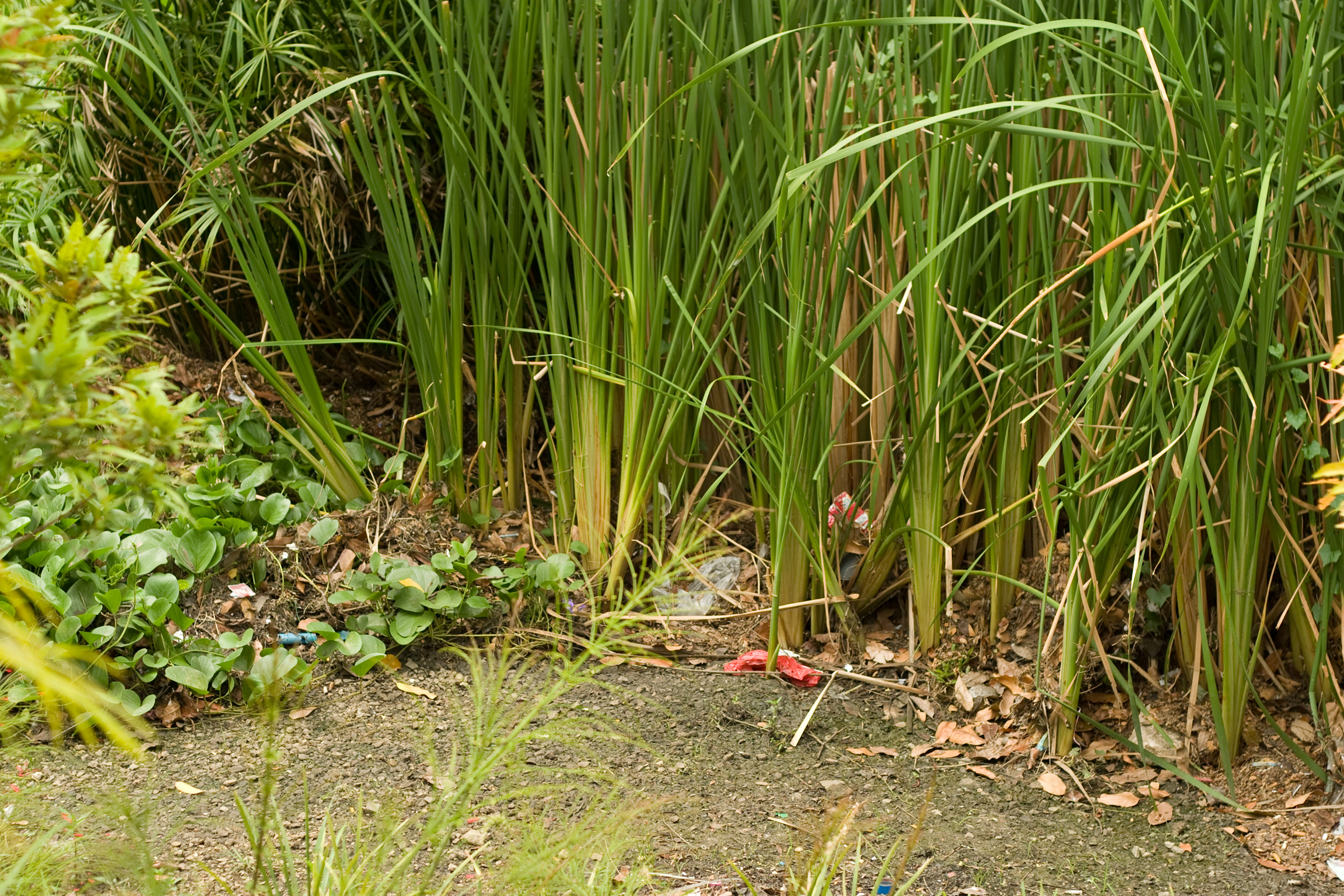
Plant selection for rain gardens needs to accommodate both temporary inundation (when the basin fills after rainfall) and relatively dry conditions between rainfall events. Plants with this tolerance include Iris pseudacorus (Yellow Flag Iris), Caltha palustris (Marsh Marigold), Carex species, and Filipendula ulmaria (Meadowsweet) — all native to most of Northern Europe and available from native plant nurseries.

Hedge planting provides boundary structure, wind filtering, and wildlife corridor function simultaneously. Photo: Wikimedia Commons / Geograph, CC BY-SA.
Hedges Over Fencing
Boundary hedges offer ecological and practical advantages over fencing in residential gardens. A well-established hedge acts as a windbreak, which reduces moisture loss from both the garden and the house. It provides nesting habitat for birds and invertebrates. It requires no treatment, replacement, or painting once established. The primary disadvantage — the time required to reach a useful height — can be addressed by selecting faster-establishing species such as Carpinus betulus (Hornbeam), which retains its brown leaves through winter, providing year-round visual screening even before it reaches full height.
Mixed native hedges — combining Hawthorn (Crataegus monogyna), Blackthorn (Prunus spinosa), Field Maple (Acer campestre), and Dog Rose (Rosa canina) — provide greater ecological value than monoculture hedges while being equally functional as boundaries. Species should be selected for compatibility with the local climate; some of the above are less suited to heavy maritime rainfall than to drier Continental conditions.
Soil Health and Organic Matter
Healthy garden soil supports a functioning ecosystem of organisms that process organic matter, fix nitrogen, suppress pathogens, and maintain soil structure. Practices that degrade soil biology — repeated mechanical cultivation, excessive synthetic fertiliser application, and leaving soil bare — reduce the soil's capacity to support plant growth sustainably over time.
The main practical interventions for maintaining soil health in a garden context are: reducing soil disturbance (no-dig or minimal-dig management), maintaining continuous surface cover through mulching or ground-cover planting, and returning organic matter through composting garden and kitchen waste.
Composting is within reach for most residential garden sizes. A compost heap requires a minimum volume of roughly one cubic metre to generate sufficient heat for reliable breakdown. Smaller gardens can use sealed composting systems or bokashi fermentation for kitchen waste. The resulting material is applied to the soil surface as a mulch or incorporated shallowly when establishing new planting areas.
Biodiversity in Residential Gardens
European Environment Agency assessments of urban green spaces note that gardens collectively constitute a substantial area of potential habitat within urbanised landscapes. Individual residential gardens vary widely in their ecological value depending on the presence of vegetation structure, diversity of plant species, and extent of hard surfacing.
Practical steps to increase biodiversity in a residential garden include: allowing a section of grass to grow long through summer (reducing mowing frequency in one defined area); installing a small pond of any size — even a 60cm × 60cm container water garden provides a breeding habitat for invertebrates; retaining a section of dead wood or log pile as habitat for wood-boring insects and amphibians; and reducing or eliminating pesticide use in areas where native planting is established.
Low-Effort Biodiversity Additions
- Allow a strip of lawn to grow uncut from May to August
- Install a minimum one nest box appropriate for local bird species (species vary by region)
- Add a small water feature — even a sunken washing-up basin with aquatic plants counts
- Plant a single native hedgerow shrub such as Hawthorn or Blackthorn if space permits
- Reduce paving coverage: each square metre of planted soil supports measurably more biodiversity than sealed surface
Further Reading
The European Environment Agency publishes reports on urban green infrastructure and biodiversity at eea.europa.eu. The RHS has published guidance on wildlife gardening and garden sustainability at rhs.org.uk.
For the structural planning decisions that precede sustainable design choices, see Planning Your Residential Garden: A Structured Approach. For plant selection matched to specific site conditions, see Plant Selection for European Climates and Soil Types.